
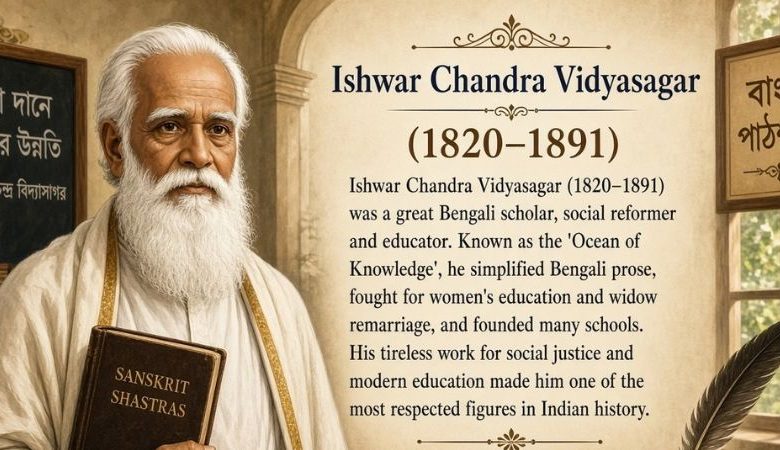
Ishwar Chandra Vidyasagar was a remarkable scholar, educator, writer, and social reformer whose work left a lasting mark on nineteenth-century Bengal. Born on 26 September 1820 in Birsingha, he rose from a modest background to become one of the most respected intellectuals of his time. His efforts went far beyond academic achievement. He worked to expand education, encouraged the education of girls, and campaigned for Hindu widow remarriage. He also made Bengali learning easier through influential works such as Barnaparichay. This Ishwar Chandra Vidyasagar paragraph collection presents his life and contributions in different word counts, making it easier for students to choose a version that suits their assignment, classwork, or examination.
Ishwar Chandra Vidyasagar Paragraph in 100 Words
Ishwar Chandra Vidyasagar was a famous Bengali scholar, educator, writer, and social reformer. He was born on 26 September 1820 in Birsingha, Bengal. Despite coming from a poor family, he worked hard and received an excellent education at Sanskrit College in Calcutta. His remarkable knowledge earned him the title “Vidyasagar,” meaning “Ocean of Learning.” He worked to improve education and supported the spread of girls’ education in Bengal. He also campaigned for Hindu widow remarriage, which contributed to the passing of the Hindu Widows’ Remarriage Act in 1856. Vidyasagar contributed greatly to Bengali literature and wrote Barnaparichay, an important book for beginners. He died in 1891.
Ishwar Chandra Vidyasagar Paragraph in 150 Words
Ishwar Chandra Vidyasagar was an eminent scholar, educator, writer, and social reformer of nineteenth-century Bengal. He was born on 26 September 1820 in Birsingha village in present-day West Bengal. His family had limited financial means, but his dedication to learning helped him overcome many difficulties. He studied at Sanskrit College in Calcutta and became highly accomplished in different branches of Sanskrit learning. His scholarship earned him the title “Vidyasagar,” which means “Ocean of Learning.”
Vidyasagar devoted much of his life to education and social reform. He worked at Fort William College and Sanskrit College and later became the principal of Sanskrit College. He supported female education and helped establish schools for girls. He also led a campaign for Hindu widow remarriage and submitted arguments supporting the reform. His efforts contributed to the Widow Remarriage Act of 1856. He also enriched Bengali education through works such as Barnaparichay. His life is remembered for combining knowledge, compassion, and social responsibility.
Ishwar Chandra Vidyasagar Paragraph in 200 Words
Ishwar Chandra Vidyasagar was one of the leading scholars, educators, writers, and social reformers of nineteenth-century Bengal. He was born on 26 September 1820 in Birsingha village in the Midnapore region of Bengal. His family was poor, but he remained determined to continue his education. He entered Sanskrit College in Calcutta in 1829 and distinguished himself through his studies of Sanskrit and other subjects. His academic achievements eventually earned him the title “Vidyasagar,” meaning “Ocean of Learning.”
After completing his education, Vidyasagar worked in important educational positions, including at Fort William College and Sanskrit College. He later became principal of Sanskrit College and worked to improve educational opportunities. He was particularly concerned about female education and helped establish girls’ schools in Bengal. The Ministry of Culture records that, as an Inspector of Schools, he established model schools in several districts and girls’ schools as well.
Vidyasagar is also remembered for his campaign for Hindu widow remarriage. He studied Hindu scriptures and presented arguments supporting remarriage. His public campaign contributed to the passage of the Hindu Widows’ Remarriage Act in 1856.
He made another lasting contribution through Bengali literature and education. His Barnaparichay became an important Bengali primer used by generations of learners. Vidyasagar died on 29 July 1891, leaving behind a legacy connected with education, literature, social reform, and humanitarian work.
Ishwar Chandra Vidyasagar Paragraph in 250 Words
Ishwar Chandra Vidyasagar was a prominent Bengali scholar, educator, writer, and social reformer whose work influenced education and social life in nineteenth-century Bengal. He was born on 26 September 1820 in Birsingha village in the Midnapore region. His family faced financial difficulties, yet he remained committed to education from an early age. He entered Sanskrit College in Calcutta in 1829 and became highly accomplished in Sanskrit learning. His exceptional academic performance earned him the title “Vidyasagar,” meaning “Ocean of Learning.”
Vidyasagar began his career in education and served at Fort William College before joining Sanskrit College. He eventually became its principal. He believed that education should reach beyond a narrow section of society and worked to improve educational opportunities. As an Inspector of Schools, he established model schools in several districts of Bengal and supported the development of girls’ schools. He also collaborated with John Elliot Drinkwater Bethune in the development of female education.
His campaign for Hindu widow remarriage became one of his most significant social reform efforts. Vidyasagar examined Hindu religious texts and argued that widow remarriage had scriptural support. In 1855, he presented a memorandum on the issue, and his campaign helped build support for legal reform. The Hindu Widows’ Remarriage Act was passed in 1856.
Vidyasagar also played an important role in Bengali literature. He wrote educational texts and helped develop clearer Bengali prose. His Barnaparichay became a widely used introductory book for Bengali learners. He was also known for charitable work and for helping people facing poverty and hardship. His life shows how education can extend beyond personal achievement and become a means of social service.
Ishwar Chandra Vidyasagar Paragraph in 300 Words
Ishwar Chandra Vidyasagar was a distinguished scholar, educator, writer, and social reformer who made a lasting contribution to nineteenth-century Bengal. He was born on 26 September 1820 in Birsingha village of present-day West Bengal. His father was Thakurdas Bandyopadhyay, and his family lived with limited financial resources. From an early age, Vidyasagar showed exceptional dedication to education. He entered Government Sanskrit College in Calcutta in 1829 and achieved distinction in several branches of Sanskrit learning. His scholarship eventually earned him the title “Vidyasagar,” meaning “Ocean of Learning.”
His professional life was closely connected with education. In 1841, he became a Head Pandit at Fort William College. He later joined Sanskrit College, became a professor, and was appointed its principal in 1851. As an education administrator, he worked to expand educational opportunities and established model schools in several districts. He also supported girls’ education at a time when female schooling faced considerable social resistance. His association with Bethune was part of the early development of organised female education in Bengal.
Vidyasagar’s social reform work was equally important. He strongly supported Hindu widow remarriage and used his knowledge of Hindu scriptures to argue that remarriage was permissible. He submitted a memorandum to the Legislative Council in 1855, and the movement he led contributed to the Hindu Widows’ Remarriage Act of 1856. He also opposed polygamy and worked toward improving the position of women in society.
His contribution to Bengali language and literature was another major part of his legacy. He wrote and adapted several books and helped make Bengali prose clearer and more accessible. Barnaparichay became an important primer for Bengali learners and remained influential for generations.
Vidyasagar was also known for his charitable activities. His concern for poor and disadvantaged people was reflected in his personal service and financial assistance. His work connected education with social responsibility, making his life significant not only in Bengal’s literary history but also in the history of Indian social reform.
Ishwar Chandra Vidyasagar Paragraph in 400 Words
Ishwar Chandra Vidyasagar was one of the most influential scholars, educators, writers, and social reformers of nineteenth-century Bengal. His contributions covered several areas, including education, Bengali literature, female education, widow remarriage, and charitable work. He was born on 26 September 1820 in Birsingha village in the Midnapore region of Bengal. His father was Thakurdas Bandyopadhyay. Although his family was poor, Vidyasagar developed an extraordinary commitment to education and continued his studies despite financial difficulties.
Vidyasagar entered Government Sanskrit College in Calcutta in 1829. His achievements in Sanskrit studies were exceptional, and he became known for his scholarship. The title “Vidyasagar,” meaning “Ocean of Learning,” reflected his reputation as a highly learned scholar. In 1841, he began working as Head Pandit at Fort William College. He later joined Sanskrit College, where he became a professor and then principal in 1851.
Education remained central to his work. As an Inspector of Schools, Vidyasagar established model schools in several districts of Bengal. He also supported girls’ education and helped develop schools for female students. His collaboration with Bethune became part of the early history of organised female education in Bengal. At a time when educating girls was opposed by sections of society, his efforts helped bring greater attention to the issue.
Vidyasagar is especially remembered for his campaign for Hindu widow remarriage. Widows faced significant social restrictions, and remarriage was strongly opposed in many conservative circles. Vidyasagar examined Hindu scriptures and presented arguments in support of remarriage. In 1855, he submitted a memorandum concerning widow remarriage, and the campaign contributed to the passing of the Hindu Widows’ Remarriage Act in 1856. He also spoke against polygamy and other social practices that affected women’s lives.
His contribution to Bengali language and literature was equally significant. Vidyasagar wrote educational texts and adaptations and helped establish a clearer style of Bengali prose. His Barnaparichay became one of the best-known introductory texts for Bengali learners and educated generations of children. The Victoria Memorial Hall describes him as an important figure in the development of modern Bengali prose.
His concern for people extended beyond formal reform. He provided financial help to people in distress and supported educational initiatives. Records also describe his close connection with Santal communities and his efforts to support education among Santal children.
Ishwar Chandra Vidyasagar died on 29 July 1891. His legacy rests on more than academic achievement. Through education, writing, public advocacy, and personal service, he contributed to important changes in nineteenth-century Bengal. His life remains an important example of how learning can be connected with social responsibility and practical action.
Ishwar Chandra Vidyasagar Paragraph in Bengali
ঈশ্বরচন্দ্র বিদ্যাসাগর ছিলেন উনিশ শতকের বাংলার একজন বিশিষ্ট পণ্ডিত, শিক্ষাবিদ, লেখক ও সমাজসংস্কারক। তিনি ১৮২০ সালের ২৬ সেপ্টেম্বর মেদিনীপুরের বীরসিংহ গ্রামে জন্মগ্রহণ করেন। দরিদ্র পরিবারে জন্ম হলেও ছোটবেলা থেকেই তিনি পড়াশোনার প্রতি অত্যন্ত মনোযোগী ছিলেন। ১৮২৯ সালে তিনি কলকাতার সংস্কৃত কলেজে ভর্তি হন এবং সংস্কৃতের বিভিন্ন শাখায় অসাধারণ জ্ঞান অর্জন করেন। তাঁর গভীর পাণ্ডিত্যের জন্য তিনি ‘বিদ্যাসাগর’ উপাধি লাভ করেন, যার অর্থ ‘বিদ্যার সাগর’।
শিক্ষার প্রসারে ঈশ্বরচন্দ্র বিদ্যাসাগরের ভূমিকা ছিল অত্যন্ত গুরুত্বপূর্ণ। তিনি ফোর্ট উইলিয়াম কলেজ ও সংস্কৃত কলেজে শিক্ষকতা করেন এবং পরে সংস্কৃত কলেজের অধ্যক্ষ হন। শিক্ষা দপ্তরে কাজ করার সময় তিনি বাংলার বিভিন্ন অঞ্চলে বিদ্যালয় প্রতিষ্ঠায় উদ্যোগী হন। বিশেষ করে নারীশিক্ষার প্রসারে তিনি গুরুত্বপূর্ণ ভূমিকা পালন করেন এবং বালিকাদের জন্য বিদ্যালয় প্রতিষ্ঠায় সহযোগিতা করেন।
সমাজসংস্কারক হিসেবেও তাঁর অবদান স্মরণীয়। তিনি হিন্দু বিধবাদের পুনর্বিবাহের পক্ষে দৃঢ়ভাবে আন্দোলন করেন। হিন্দু শাস্ত্রের ব্যাখ্যার মাধ্যমে তিনি বিধবা বিবাহের পক্ষে যুক্তি তুলে ধরেন। তাঁর প্রচেষ্টার ফলে ১৮৫৬ সালে হিন্দু বিধবা পুনর্বিবাহ আইন পাশ হয়। তিনি বহুবিবাহের বিরুদ্ধেও মত প্রকাশ করেন এবং নারীদের সামাজিক অবস্থার উন্নতির জন্য কাজ করেন।
বাংলা ভাষা ও সাহিত্যের ক্ষেত্রেও বিদ্যাসাগরের অবদান অসাধারণ। তাঁর লেখা বর্ণপরিচয় বাংলা ভাষা শেখার একটি গুরুত্বপূর্ণ প্রাথমিক গ্রন্থ হিসেবে বহু প্রজন্মের শিক্ষার্থীর কাজে এসেছে। বাংলা গদ্যকে সহজ ও স্পষ্ট করার ক্ষেত্রেও তাঁর গুরুত্বপূর্ণ ভূমিকা ছিল।
ঈশ্বরচন্দ্র বিদ্যাসাগর শুধু পণ্ডিত ছিলেন না, তিনি ছিলেন একজন মানবদরদি সমাজসেবকও। দরিদ্র ও অসহায় মানুষের পাশে দাঁড়ানো, শিক্ষার প্রসার এবং সমাজের বিভিন্ন সমস্যার বিরুদ্ধে কাজ করা ছিল তাঁর জীবনের গুরুত্বপূর্ণ অংশ। ১৮৯১ সালের ২৯ জুলাই তাঁর মৃত্যু হয়। শিক্ষা, মানবতা ও সমাজসংস্কারের জন্য তাঁর অবদান আজও শ্রদ্ধার সঙ্গে স্মরণ করা হয়।
Why Is Ishwar Chandra Vidyasagar Remembered?
Ishwar Chandra Vidyasagar is remembered for bringing together scholarship and social action. His importance does not come from one achievement alone. He contributed to education, supported girls’ schooling, campaigned for widow remarriage, worked against social practices such as polygamy, and helped shape Bengali educational literature.
His work also shows why his name continues to appear in school lessons. He used his education outside the classroom, addressing social problems that affected ordinary people. His efforts therefore became part of the wider intellectual and social changes taking place in nineteenth-century Bengal.
Wrapping Up
Ishwar Chandra Vidyasagar’s life was shaped by education, reform, and service. From overcoming financial hardship to becoming a respected scholar, he used his learning to address wider social problems. His work for girls’ education and widow remarriage became important parts of nineteenth-century Bengal’s reform movement, while his Bengali books helped generations of students learn their language.
For students looking for an Ishwar Chandra Vidyasagar paragraph, the different versions above give you options based on the required word count. More importantly, his life offers a clear lesson: education becomes more meaningful when knowledge is put into practice for the benefit of society.
Frequently Asked Questions (FAQs)
Q1. Who was Ishwar Chandra Vidyasagar?
Ishwar Chandra Vidyasagar was a Bengali scholar, educator, writer, and social reformer who worked extensively for education and social reform during the nineteenth century.
Q2. Why was Ishwar Chandra called Vidyasagar?
He received the title “Vidyasagar,” meaning “Ocean of Learning,” because of his exceptional scholarship, particularly in Sanskrit studies.
Q3. What did Ishwar Chandra Vidyasagar do for women’s education?
He supported female education and helped establish girls’ schools in Bengal. As an Inspector of Schools, he also worked to expand educational institutions in different districts.
Q4. What was Ishwar Chandra Vidyasagar’s role in widow remarriage?
He campaigned for Hindu widow remarriage, supported his arguments through interpretations of Hindu scriptures, and submitted a memorandum on the issue. His campaign contributed to the Hindu Widows’ Remarriage Act of 1856.
Q5. What is Ishwar Chandra Vidyasagar famous for?
He is particularly remembered for his contributions to education, female education, widow remarriage reform, Bengali literature, and social service. His Barnaparichay also became an important Bengali primer.

